Technology


Art& Internet& Technology25 Apr 2008 01:15 pm

Close up of Lafayette Crosses Memorial

Heading into SF on BART last Tuesday on business, noticed the growth and development of the Lafayette Crosses memorial. Here are a few photos of how it looked.

My appointment in SF took me near the Moscone Center, where the Web 2.0 Conference was readying for its open on Wednesday. It seemed quiet. Not much to shoot photos of. Looked at the Web 2.0 program and did not see companies listed that I perceive to be collaborative, social networking websites. Instead I noticed large computer and telecomm corporations, and Disney.com. Since when is Disney collaborative?

What a joke. The best way to get into Web 2.0 is to use it on the web. The rest is just hype. Back in Lafayette stands a truly collaborative work, low tech, with heart and humanity… but at what a cost.

Lafayette Crosses memorial at 4039

  • Share/Bookmark
Media& Technology20 Sep 2007 08:01 am

Here is an experiment using Slide to build a slideshow from my Photoshop collages posted on this blog.

  • Share/Bookmark
Technology24 Aug 2007 04:58 pm

Broken CDI’ve been away for awhile… on vacation, at the beach, golfing, working on a project that is way past due, hovering between boredom and stress, poverty and contentment.

Anyway, I thought I’d post a nice bloggy woggy entry with an old classic Grebe black and white photo of a guy with his shirt off sitting on park bench near the Brooklyn Bridge. So, I get out my old Kodak Photo CD with 100 of my favorite film negatives from the 70’s, 80’s and 90’s scanned in the Kodak Photo CD format way back in 1996. Now here is what makes the technology era so frustratingly, rapidly changing: it turns out Photoshop CS3 and CS2 fail to open these files!

When Googling the problem, a link to Adobe came up, but their solution did not work on my Apple Mac G5.

There are lost image pioneers that have gone before me in this search for solutions, such as Ted’s Unofficial Kodak Photo CD Homepage. I guess my previous versions of Photoshop’s PhotoCD plugins were OK, or I would have noticed this gross legacy error sooner. Another entry is from the year 2000, “What ever happened to the Photo CD?”

Kodak, you losers. You deserve to die a slow death in the transition from film to digital.

  • Share/Bookmark
Technology& User Interface29 Jun 2007 08:33 pm

iPhone Waiting LineiPhone iWait.org line waiters

Hobnobbing in front of Walnut Creek’s Apple Store with the iWait.org crowd, who were holding places on line to be among the first to purchase the highly anticipated new Apple iPhone.  Visiting around 4 pm, I asked an iWait kid, about number twelve in line, how much he was selling his place in line for.  His answer, “Two-fifty.”

The glass front of the Apple store was covered from the inside with heavy black paper, I assume to be unveiled at the 6 pm iPhone sales opening. There was a carnival atmosphere building Friday evening at Walnut Creek’s upscale shopping district, the pulse quickening with iPhone launch excitement.

For those who care not to wait, there are plenty of exotic phone gadgets already on the market, such as this Verizon LG model (below).
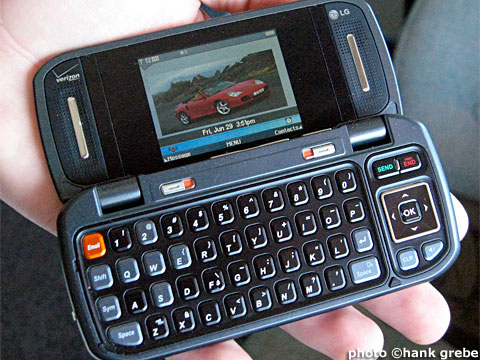
Verizon LG phone

  • Share/Bookmark

Tags: , , , ,

Animation& Technology09 May 2007 08:08 am

SIGGRAPH 2007 logoI first attended a SIGGRAPH convention in 1983. The International Conference and Exhibition on Computer Graphics and Interactive Techniques was held in Detroit that year. I traveled with Tim Onosko, a technology writer from Madison, Wisconsin, to learn about pixels and how computers were able to help with the laborious process of animation.

Traditional cel animation had no inate ability to illustrate 3D geometry, only providing photographic 2 1/2 D depth through multiplaned layers of glass shot on the animation camera stand. In the 70’s I had worked on a few independent cel animated projects with Steven Lisberger in Boston, and we imagined that in the future perhaps computers would replace the drudgery of inking and painting acetate cels. I was shocked to see Steve had moved into 3D computer animation when he wrote and directed TRON, and I was determined to catch up on this innovation.

SIGGRAPH 1983 was a rush of excitement, a real eye opener. I attended a 2 day course presented by staff members of NYIT’s computer graphics lab; Fred Parke, Duane Palyka, and Lance Williams to name a few. They were writing their own software and systems to aid 2D painting, tweening and 3D animation. At small gatherings and parties I met some of the leading thinkers in new media at the time, such as Gene Youngblood whose book EXPANDED CINEMA had influenced me greatly in my earlier undergraduate film school studies.

There was a great sense of anticipation and invention. The software engineers and artists at SIGGRAPH 1983 knew they were staring at a wide open territory fresh for developing new frontiers in 3D animation, gaming and filmmaking. Back in those days, the animation industry itself was weak. MTV was just starting to spark new creative endeavors in music video production. Pixar, The Cartoon Network, Comedy Central, Ren and Stimpy, Beavis and Butthead, South Park – none of these had happened yet.

By 1984 I was working at NYIT Computer Graphics Lab as a 2D compositor, experimenting with animating a 3D Gumby model which appeared as part of the SIGGRAPH 1984 Electronic Theater. In 1985 and 86 I was NYIT’s post production director for their SIGGRAPH show reels.

The upward momentum of computer graphics and animation in those days was even more intoxicating than the great Internet ramp up and bubble in the late 90’s. Yet today, you can’t escape the influence of computer graphics. Animated pixels and visual effects are part of almost every motion picture, television show and certainly every computer monitor. I would argue that today there is as much or more artwork generated by computer artists than by traditional painters and sculptors.

SIGGRAPH has lost that magical luster of cultish wizardry for me. It’s a routine convention machine now, carefully connecting large educational institutions with large corporations and influencial Hollywood studios. Also, in the past, employers were more willing to help pay your way to a special conference such as the SIGGRAPH that once was. Now the corporations are tighter, and travel expenses to just another convention are often seen as an obstacle. Although the mystical secret genie of SIGGRAPH was out of the bottle over 10 years ago, if I were paid to cover SIGGRAPH I’d go and know what to look for.

SIGGRAPH will still be full of great technical papers, panels taught by smart guys looking to have some of their costs covered, and more student animation than you will have time to sit through. So for me it’s more of the same, mostly redundant stuff, and not the excitement of riding a remote new wave with a small band of pioneers that it used to be.

As the Donald Fagen song The Goodbye Look goes…

The rules are changed, it’s not the same
It’s all new players in a whole new ball game.

  • Share/Bookmark
Internet& Technology& User Interface28 Mar 2007 07:43 am

EtOoQFa5ug8

Last summer a Senator from Alaska, Ted Stevens, fumbled through his description of the Internet as a “series of tubes.” His simplification was a clumsy adaptation to what telecom folks colorfully refer as “pipes”, network bandwidth such as fiber optical cables providing faster transmission speeds and therefore a “fat pipe.” In 3 to 5 years IBM promises we will have much, much fatter pipes. (Link to full story.)

“We have worked out a way to ship almost inconceivable quantities of data at extremely low power,” said Bernie Meyerson, chief technologist for International Business Machines Corp.IBM optical chip

Imagine 160 Gigabytes of data or an entire HD movie being downloaded to your computer or DVR box in one second! The implications of this new chip are staggering. Codecs, audio and video compression technologies, such as MPEG used in mp3, DivX and all the rest will no longer be necessary. Larger hard drives and bigger memory storage devices to collection your new tidal wave of data will be necessary. Online video web sites will contain larger, higher resolution clips which will certainly compete with traditional television broadcasting stations to a larger extent than they do now. Peer-to-peer networking schemes will be more important for sharing vast storage resources than bandwidth itself. Networked games will become higher resolution and more interactive. I can imagine two remotely located Nintendo Wii users playing a lifesized game of tennis through the network. My mind is on fire with ideas, get me a VC quick!

  • Share/Bookmark
Animation& Technology24 Mar 2007 08:55 am

Still of Spot Draves from Sheepumentary video

Scott aka Spot Draves has been developing an open source network rendered screensaver, Electric Sheep for over 10 years. The project has grown in size and capability, and Spot is receiving recognition within the computer art world and the fine art gallery scene as well. Spot stopped by the Tubular TV studio and we videotaped an artist’s statement as well as an informal interview. See it over at my videoblog, Tubular TV.

Since posting this episode on our video web host, blip.tv, they have cited it on their home page as one of their “Hot Episodes.”  Thank you blip.tv, we think you’re hot too.

  • Share/Bookmark
Animation& Technology05 Mar 2007 10:31 am

CalendarIt’s high time I started using Maya’s mental ray renderer. I’ve been stuck in the Dark Ages with Maya until recently working on a project demanding high end renderings. This animated calendar image on the right makes use of mental ray’s image based lighting option. Thanks go to team member Ruby Rieke for helping me to get up to speed on mental ray texturing.

Maya Nucleus example 3D rendering Keeping up with Maya’s many complex features is a daunting task. Recently Autodesk announced Maya Nucleus, new dynamics features providing improved interaction between colliding objects. They’ve got a dozen QuickTime movie animation examples of the amazing physical dynamics Nucleus is capable of. How dynamic I am in learning to use the powerful tools is another problem.

  • Share/Bookmark

Tags: , , , , , ,

Media& Music& Technology30 Nov 2006 10:21 pm

The MGM Grand Las Vegas

Originally uploaded by Wolfgang Staudt.

In a few days I will be joining the famous video blogger Nick of schmult.com, the TechieDiva and rising TV presence Christianna M to cover the Billboard Music Awards for our newly launched Tubular TV vlog site. Nick seems to be equipped to video blog everything, so it might be a bit uncomfortable sharing a room with this dude. How far will he go to get more hits?

Britney Spears, help!

  • Share/Bookmark
Technology& User Interface16 Nov 2006 03:18 pm

Multi-Touch Interaction ExperimentsWhy of course, it’s only a refinement of the Frustrated Total Internal Reflection sensing technique.  See the cool video displaying virtual DJ platter interaction on the big colorful touch screen.

  • Share/Bookmark
Animation& Media& Technology04 Mar 2006 07:47 pm

Underworld creatures

Luma Pictures recently produced 200 monstrously realistic visual effects shots of vampires and werewolves for the recent horror movie UNDERWORLD: EVOLUTION. Apple’s web site has a good write up of the software and visual effects techniques of Luma’s artists on Underworld, Crash and The Cave. The 3-D modeling, animation and compositing is very high end.

Luma’s work generated a VFX Forum discussion which includes an excited artist bubbling over his first film experience. Looking at the trailer I am too removed from the excitement. With all the real life horrors in the world, what is so scary about this old fashioned hocus pocus stuff?

  • Share/Bookmark
General& Internet& Technology03 Feb 2006 10:41 am

Jogging RouteSatellite Jogging Route

Google Maps Mania, an unofficial Google Maps blog, was recently covered in an NPR news story. The site has many cool links to individual interests based on locations.

Satellite view of a lion landscaping sculpture A related site, Google Sightseeing, is themed around collecting eye catching satellite photographs.

Yahoo’s new Flash-based maps also have an API that can be accessed and customized, as seen at the Programmable Web blog. Yahoo is also developing a Local Events browser based on their maps, as described by a Yahoo! developer’s blog. Other Yahoo map users linked their videos to locations.

  • Share/Bookmark

Tags: , , ,

Next Page »